

When Roles Change: How School Chaplain Programs Differ from Traditional Chaplaincy
A closer look at the network behind the modern “chaplain movement.”

Leave a Comment / By Rhonda Thomas / Originally Published at Liberty Sentinel
May 19, 2026
In 2023, Texas became the first state to authorize public-school chaplains under Senate Bill 763. Florida followed in 2024 with House Bill 931, inviting volunteers to serve as “chaplains” for students. Proponents hailed both bills as victories for faith and freedom, restoring a moral compass to classrooms. Yet a closer look at the network behind the modern “chaplain movement” reveals something far more complex: a pipeline of organizations that repackage spiritual care as emotional management and recast the pastoral role as a tool of social engineering.
From SEL to Spiritual Care
The story begins not with the pulpit but with psychology. In the 1990s, the Fetzer Institute, a Michigan-based philanthropic foundation devoted to “spiritual transformation,” funded and helped shape the early frameworks for what would become Social and Emotional Learning (SEL). Fetzer later described its role this way: “Our commitment to whole-child education dates to the 1990s, when we played a significant funding and organizing role in what would become social and emotional learning.”
That early investment gave rise to CASEL, the Collaborative for Academic, Social, and Emotional Learning—now the leading authority on SEL implementation in U.S. schools. CASEL’s history lists David J. Sluyter, Senior Advisor at the Fetzer Institute, as a founding team member. Fetzer’s humanistic vision of “whole-child spiritual flourishing” thus became embedded in public education as state-mandated emotional conditioning.
SEL’s five core competencies—self-awareness, self-management, social awareness, relationship skills, and responsible decision-making—sound benign. Yet they redefine morality by emphasizing emotion and replacing virtue rooted in truth with behaviors deemed socially harmonious. That same deception now reappears under a new banner: chaplaincy.
The Chaplaincy Innovation Lab: A Fetzer-Funded Bridge
Two decades after Fetzer seeded SEL, it turned to professionalizing spiritual care through the Chaplaincy Innovation Lab (CIL) at Brandeis University. CIL describes itself as “the leading cross-sector network for research and education in chaplaincy and spiritual care.” Its project states, “Funded by the Fetzer Institute, this initiative supports networks of spiritual-care providers who identify as spiritual but not religious.”
That phrase—spiritual but not religious—defines CIL’s core mission: training chaplains to work comfortably in secular institutions, detached from any theological anchor. The model emphasizes empathy, trauma response, and “inclusive spirituality.” CIL’s language mirrors CASEL’s competencies: emotional regulation, social awareness, and ethical decision-making. SEL’s vocabulary simply migrated from classrooms to chaplain training.
Fetzer’s financial and philosophical fingerprints on both SEL and CIL reveal a through-line: the transformation of spirituality into humanist-based psychological well-being with eastern mysticism or universalist tones. Where schools once taught civics and moral reasoning, they now administer emotional therapies. Where chaplains once preached Scripture, they now manage “spiritual wellness outcomes.”
The United Nations Chaplains Association: Expanding the Reach
Enter the United Nations Chaplains Association (UNCA), a U.S.-based nonprofit that claims to operate “throughout the continental United States and the Caribbean.” Its mission: “Promoting social and economic development, crisis counseling, disaster management, and leadership engagement.” It operates “Crisis Counseling & Intervention Units” and “Community Care Coalitions,” deploying chaplains trained in trauma response, emotional stabilization, and interfaith cooperation.
Despite its name, UNCA does not appear on the official United Nations NGO registry and has no documented consultative status with the United Nations. Yet its rhetoric closely mirrors the United Nations Sustainable Development Goal 4.7 (SDG 4.7), which calls for “education for sustainable development and global citizenship.” By combining humanitarian outreach, emotional counseling, and leadership training, UNCA effectively translates the SDGs’ moral framework into a chaplaincy practice—spiritual globalization presented as community care.
The overlap in mission language is unmistakable: “social development,” “emotional resilience,” and “leadership for peace.” These phrases originate in UN and Organization for Economic Co-operation and Development (OECD) policy papers, but now reappear in American schools through programs that they present as faith-neutral chaplain programs.
From Policy to the Classroom
During the Texas legislature’s debate over SB 763, supporters argued that chaplains could ease the burden on overworked counselors and address student mental health crises. The law permits districts to “employ or accept as volunteers, chaplains to provide support, services, and programs for students as assigned by the board.” It imposes no requirement for certification, ordination, or professional counseling licensure. Amendments that would have required parental consent for student interactions were rejected.
Florida’s HB 931 added limited safeguards—background checks and parental notification—yet left the term “chaplain” undefined. Across both states, the outcome is the same: anyone trained in interfaith or psychological models can now serve as a spiritual-emotional counselor in public schools.
Meanwhile, the National School Chaplain Association (NSCA), founded by Rocky J. Malloy, has promoted such legislation nationwide. Malloy previously led Mission Generation, which described its curriculum as “Bible-based Social Emotional Learning.” In 2022, he headed Hope Rising, a program that explicitly framed SEL as the vehicle for moral development. In other words, Malloy’s statements link SEL and chaplaincy, confirming that the two frameworks share not only language but also lineage.
Convergence of Systems
Taken together, these institutions form a coherent structure
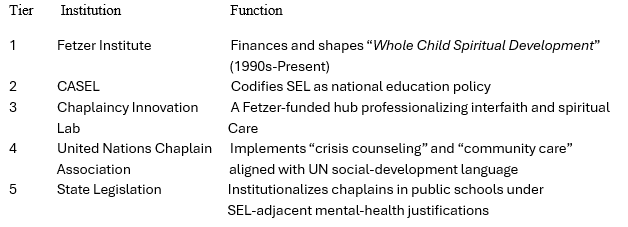
What emerges is a humanist bureaucracy cloaked in spiritual language, not a revival of a biblical worldview. It advances a global ideology of emotionally coerced consensus, moral relativism, and civic conformity, administered through psychology rather than faith. While CASEL teaches emotional intelligence, CIL and UNCA enforce emotionally orthodox conformity. Both serve the same end: managing belief by managing feelings.
A New State Religion
The irony is striking. Public schools that long banned prayer and Scripture now invite state-approved chaplains trained in “pluralistic spirituality.” The old objection—that religion has no place in government institutions—has been replaced by a subtler creed: religion without divine revelation. This system preserves the ritual veneer of compassion while stripping away God’s authority and replacing conscience with fear-driven compliance.
In practical terms, the chaplain bills expand the broader system of emotional and behavioral governance already embedded in frameworks such as Social Emotional Learning (SEL), the Dignity Index, Positive Behavioral Interventions and Supports (PBIS), and Multi-Tiered System of Supports (MTSS). These models increasingly position schools not merely as academic institutions but as centers for managing students’ emotional well-being, relationships, identity development, and behavioral outcomes.
CASEL’s SEL framework, for example, promotes competencies tied to self-management, social awareness, relationship skills, and responsible decision-making, while researchers associated with “Civic SEL” openly link social-emotional competencies to civic attitudes and democratic engagement. Each additional layer—including counselors, social-emotional coaches, mindfulness instructors, and now chaplains—extends institutional influence further into students’ interior lives, shifting responsibilities once held by families and churches into the hands of state-connected systems. It is, in effect, the creation of a public-school priesthood without theology, credentialed through networks tracing back to therapeutic humanism, emotional governance models, and global “whole child” frameworks associated with organizations such as the Fetzer Institute and UNESCO.
Military vs School Chaplain Training
The contrast between U.S. military chaplains and many school chaplain models is significant. Military chaplains must complete extensive theological education, accredited seminary training, ordination, endorsement by recognized religious bodies, clinical pastoral training, and operate under strict federal oversight and accountability standards.
By comparison, school chaplain programs such as NSCA have far fewer standardized requirements and often lack uniform standards for training, counseling, or oversight. This raises concerns about qualifications, accountability, parental rights, and the placement of underqualified spiritual or emotional support personnel in positions of influence over children.
Conclusion
The chaplain bills now advancing across multiple states promise moral restoration but deliver deceptive manipulation. Behind them lies a web of philanthropic and intergovernmental interests that has spent three decades merging psychology, education, and faith into a single system of pseudo-emotional management, which is really behavior control. If Texas and Florida are the first to open that door, the question is not whether chaplains belong in schools, but whose doctrine they will preach upon arrival.
Rhonda Thomas is the President of Truth In Education (TIE), a Christian nonprofit based in Atlanta dedicated to exposing harmful ideologies, Marxist influences, and globalist agendas in America’s schools while advocating for parental rights. TIE equips families and churches to reclaim their biblical role in educating children by promoting homeschooling, supporting the launch of Christian schools, and empowering parents to stand firm in the spiritual battle for the hearts and minds of the next generation.